
A Ritual of Wonderment: Pacific Northwest Ballet's "The Nutcracker", Ten Years Later
- Louise Greer
- Dec 10, 2025
- 14 min read
Updated: Jan 17

“The most wonderful things can be seen if you have the right sort of eyes for it.”
-E.T.A Hoffmann
Perhaps because it comes around every December, its broad audience appeal that keeps ballet companies afloat, or because of its child-centered story, the world’s most performed ballet is, ironically, greatly trivialized. Even at its 1892 St. Petersburg premiere, The Nutcracker was mocked for its simplicity, nonsensical storyline, and unusual structure; its intricacies, overseen, its psychological depth, underappreciated.
Yet, 133 years later, there are few sights that strike such profound awe as when snowflakes gently drift through towering birch branches for the first snowfall of Nutcracker season. During Pacific Northwest Ballet’s opening performance, the overwhelming sentimentality was audible, a reminder that this annual tradition is, for many people, much more than a ballet. It is a tangle of memory, wonder, and some of the world’s purest beauty that we are lucky enough to return to year after year.
Innovation may keep ballet alive, yet as The Nutcracker proves, so does tradition. The yearly return of Nutcracker gives a country often lacking in collective cultural traditions a secular rite in the year's darkest days. There is great comfort in the fact that no matter what occurs between January and November, come the day after Thanksgiving, there will always be this elaborate spark of delight to brighten the gray. Even five years ago, as McCaw Hall sat deserted, The Nutcracker found a way to spring before our eyes. It is a ritual in its own right.
This year, Pacific Northwest Ballet’s production of George Balanchine’s The Nutcracker celebrates its tenth anniversary, though it's difficult to believe there was a time before these bright hues decked the stage. Bold patterns, humorous mice, a bed traveling through a layered birch forest, marzipan upon crisp doily, the warm glow of a sea of flowers framed by mint and strawberry stripes… add Balanchine’s ingenious musicality and it’s not hard to see why this production has become a beloved classic in its ten years of enchanting Seattle.
Jennifer Homans calls Balanchine’s Nutcracker a “memory of a memory”, for it is steeped with visions of imperialist Russian passed through Petipa and on to Balanchine. Balanchine’s Nutcracker is filled with his memories of revivals of the St. Petersburg production, with some choreography, such as Candy Cane, and the Prince’s pantomime, quoting directly from the original. But, Balanchine’s Nutcracker is shaped by entirely different values and aesthetics. In “Nutcracker Nation”, Jennifer Fisher remarks: “Balanchine’s new style of classicism, his rapid transitions and complex maneuverings, are always there…but he also embraced the ballet’s inner child years before anyone used that term or thought through its implications in a story ballet.”
In St. Petersburg, early critics heavily critiqued The Nutcracker for its use of children in lead and supporting roles. Seeing childlike behavior on the imperial stage simply didn’t fit, but when it came time to craft his own Nutcracker, Balanchine didn’t view children as a hindrance in a ballet about childhood. Rather, he gave them both the age-appropriate childlike renderings of the party scene, and the technical challenges of the second act divertissements that show these young dancers as already well-developed artists. He trusted these children to show the caliber of education at his School of American Ballet, and likewise, PNB’s students do the same.
Each year, four bright students are chosen to take on the cherished roles of Clara and the Prince in Pacific Northwest Ballet's production of The Nutcracker. This year’s casting reveals a particularly bright future for the art of ballet. June Grossman, beautifully vivacious in her characterization of Clara, is one of the most delightful Claras I’ve seen in years. Her animated elation, and genuine awe flood every moment she is on stage. If it is real to Clara, then it can be real for us as well, and through Grossman’s eyes, the wonder of The Nutcracker grows tenfold.
In 2022, the most lively, rambunctious Fritz stole the show, and this year, it is no surprise that the same Maxwell Adams steps into the Prince’s shoes with passion exuding from every step. In battle, he brings the Nutcracker to life with uncanny and serious devotion, and when battle gives way to drifting snow, his heaven-directed awe is enough to, at least for a moment, let us forget we’re in a theater after all.
George Balanchine once played the coveted role of the Prince at the Mariinsky Theatre, and the Act Two pantomime narrative is one of the threads that connects today’s performance to the original 1892 production. As Adams told this tale before the Sugar Plum Fairy and her court, it was not memorized mime that fell from his hands, but rather a story ushered forth in a native language of his. Real to him, and therefore, overwhelmingly real to us. It is enough to bring one to tears, to see a child so dedicated to the present moment, and to an art form which they were clearly destined to inhabit.
It seems that in a ballet filled with so many roles, each small inflection may not affect the whole quite as greatly, but the opposite is true. From the maternal gestures of Mrs. Stahlbaum (an enlivened beacon of devoted warmth and generosity in Elle Macy’s hands, who continues to prove herself as a consummate artist even when not dancing), to Fritz’s feisty antics; from the mice who seem to be having the time of their lives, to each dear flower who, some twelve shows later, still glow with awe for what they are part of…there is always a new delight waiting to be seen.

The Nutcracker is ritualistic in its constant return, a ballet that follows a dancer through life more than any other, that holds the arc of a career, from tiniest angel to the corps de ballet dancers carrying the ballet all month long, to the defining role of Sugar Plum Fairy, to character artists stepping into Drosselmeier’s shoes.
Many productions cast Drosselmeier in a sinister light, but in Balanchine’s reshaping of Hoffmann’s tale, Drosselmeier is softened, so that even as he creeps about the darkened living room, there could be nothing menacing in his heart. During opening weekend, Dylan Wald’s vivid portrayal made me wish that just this once, Drosselmeier could venture on into the Land of the Sweets, for his presence is a delight. Wald’s Drosselmeier is young in manner, still filled with a spry, childlike wonder, and nimble through every accentuation of joy. As with all things he does, Wald’s earnest care is evident in his fully-present characterization. In that one eye shines a bounty of whimsy, a glowing warmth that is the most captivating sight amidst the party scene’s bustle.
One of Balanchine’s greatest gifts in The Nutcracker is the ability to present both the domestic and the virtuosic side by side. His party scene is imbued with the “home and hearth” values of the 1950s, filled with a bustle of details, manners, and relationships that create a nostalgic picture of days gone by. As Edwin Denby remarked shortly after the 1954 premiere, the languid unfolding of scene “creates the large time in which childhood events occur, the amplitude out of which fantasy takes shape.” Unlike many other adaptations, Balanchine honors childhood by letting children act like children, and allowing Clara to remain her tender age without the idealized rush to spring to adulthood even in dream. Later, in a touching gesture of tranquil domesticity, the mother who sweeps through the darkened house to find a sleeping Clara is one of the many treasures of Balanchine’s production. With Tchaikovsky’s swelling Entr’acte taken from The Sleeping Beauty (played with such splendid soul by Michael Jinsoo Lim night after night that it is reason enough to buy a ticket, just to hear this yearning melody resound live), the world comes to a still.
Despite spending half of The Nutcracker’s budget on the tree alone, Balanchine knew that the tremendous transformations and stage magic could not overshadow his choreography. No grand vision could turn into empty spectacle, or distract from his ingenious shaping of both quiet wonders and meticulous compositions of form. He knew when to let the music speak for itself (as when Clara’s bed travels through a building forest), and when to let plot quell for the sake of pure balletic brilliance.
As in Waltz of the Snowflakes, a scene which unfolds so wrought with beauty that one can only be overcome with awe. Balanchine’s prolific architecture of pattern builds a propulsion of darting snowflakes, gathering and vanishing, scattering with crystalline definition and aptitude. It’s a man-made wonder, a masterful flurry sharpened by his characteristic velocity, syncopation, and accents. Though it does not feature the nearly sixty snowflakes that the 1892 production did, Balanchine’s dynamic directionality and musically-aligned canons swirl sixteen dancers into a breathless blizzard of tulle.

When Act Two reveals a hazy field of gleaming gold, filled with sweet angels who glow in their candle’s light, we do not question how we’ve arrived in such a place. As Edwin Denby observed in 1954, The Nutcracker allows grown-ups the opportunity to “slip back into a world they have left”. A world which brims with possibility and wonder, where sweets vaguely reflect national dances and appear before us, instantly specific in their character and movement motifs. In Act Two, the opportunities for interpretation of beloved divertissement roles means that no performance will ever resemble the next. It is always fresh, always spun with new flavor.
Though the enrapturing joy of Hot Chocolate finds it’s far-too-brief vibrancy in many pairings, it was Christian Poppe’s gust of might beside the gleeful Melisa Guilliams, as well as Juliet Prine, brimming with radiant strength and flair while having the time of her life with Luther DeMyer, that lingered days later.
Coffee, full of contracting, expanding curves and rhythm is a spell under which we eagerly fall. Madison Rayn Abeo’s forte has always been the savoring of details, and in Coffee, her curling ribbon of a hand, and flourishes of character catch the light with entrancing fluidity. Likewise, Amanda Morgan’s mysterious poise, and Lily Wills’ sultry allure are all-possessing in this dark enchantment.
Green Tea Cricket may only have turned four years old, but he’s already a beloved member of the Nutcracker crew. During opening weekend, these interpretations included Noah Martzall, spring-loaded and exuberant, Joh Morrill, buoyant and brimming with delight, and Dylan Calahan, a blur of finesse–so expansive that he nearly bounded off into the wings.
The first joyous Candy Cane of the season found Mark Cuddihee racing out of the wings with all the energy in the world. Ryan Cardea too, found intense canned vigor, and as for Joh Morrill, his charisma is filled with the delight of “Watch this! See this wonder!”. Luca Anaya possesses a similar quality, all contagious vim and enthusiasm through every daring hoop jump.
Marzipan is forever underappreciated for its technical intricacies, and that may partially be due to the fact that the dancers of Pacific Northwest Ballet make each trying demand look effortless. Destiny Wimpye, ever so bright, is a soaring exuberance. A burst of vitality, Rosalyn Hutsell makes all the subtleties of Marzipan look like nothing but sheer spontaneous glee. Last year it struck me how Yuki Takahashi somehow imbues the choreography with the very essence of a lemon’s lively tang, and in neat accentuations, her refined delicacy glows.
Each night, Mother Ginger takes on a new persona, and every time, it’s a thrill to see who will emerge from the wings. During opening weekend, it was Connor Horton’s Mother Ginger who nearly stole the show. Counting the children in a panic, whirling into a feigned dizzy spell, and doing the choreography with them, his Mother Ginger is utterly charmed by her darlings. In her towering shadow, the impossibly small polichinelles were tasked with so much by Balanchine, and are exceptionally well rehearsed this year.
The wonder of Balanchine’s Waltz of the Flowers is that when performed with the right intention, Dewdrop becomes an ode to the love of dance. She is one of the most spritely roles in the canon, dashing through billowing flurries of tulle and brilliant kaleidoscopic patterns with effervescent glee. Amidst a sea of sunset hues, a harp calls her to find her rightful place, and we see instantly in her uprightness, what luminosity defines her.
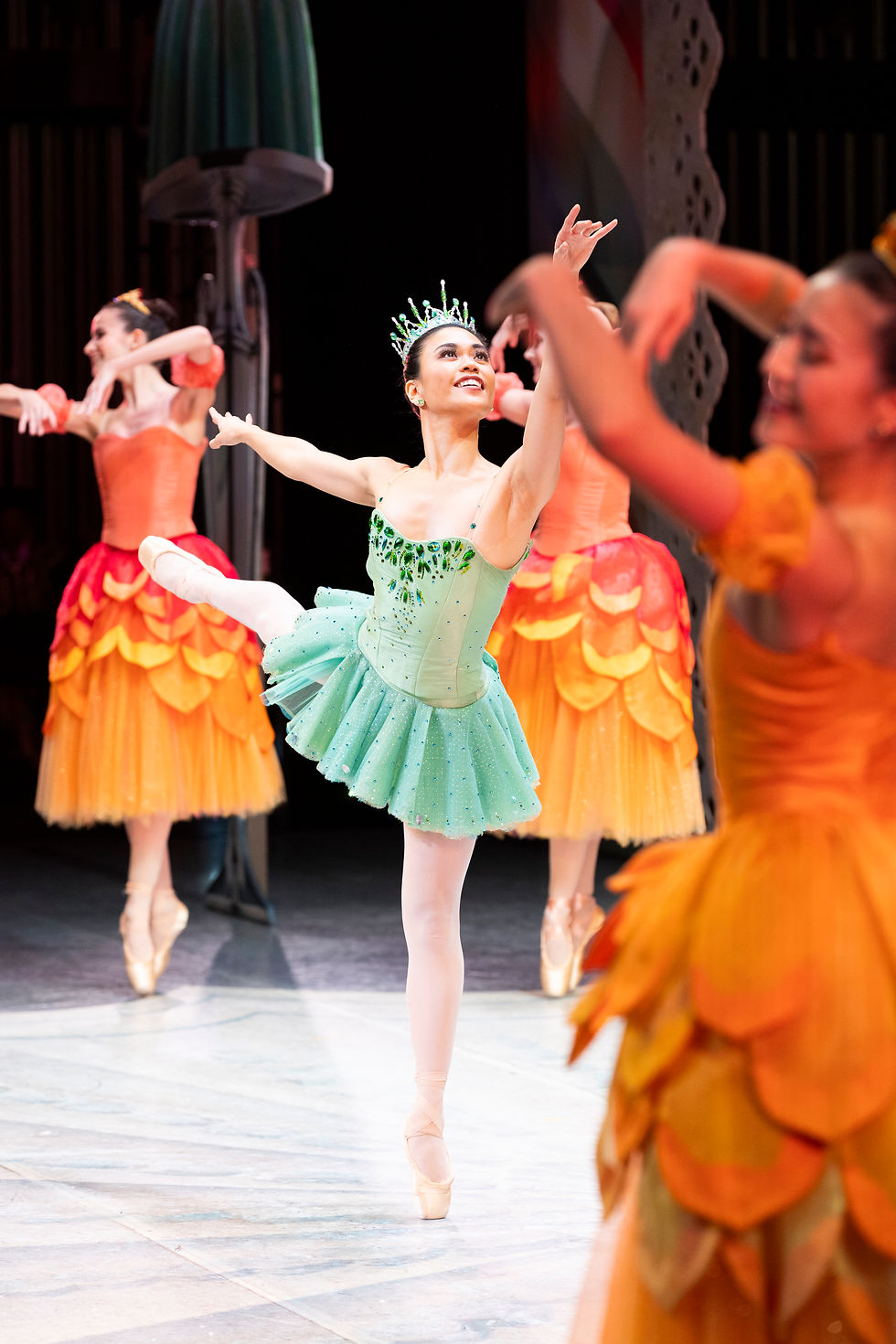
It should come as no surprise that in a role known for its whimsical musicality, crafted with such intuitive acuity by Balanchine, Angelica Generosa finds each tender beauty. Like Balanchine himself, she knows when to stretch a glimmering pause, when to put meter and step in juxtaposition while retaining its harmonious effect, and when to relinquish to Tchaikovsky. Generosa’s savoring of each brisk delight, not to mention the unwavering control that slowed the hands of time during a breathtaking attitude turn, make her Dewdrop invigoratingly resplendent.
Entering with her heart forward, Madison Rayn Abeo’s radiant Dewdrop glows with love for this art, and for each interwoven delicacy. Flourishes of her own invention abound with ease, nuances marked by sprite, gleeful levity and a genuine gleam which could only be her own. Abeo has a remarkable ability to find stillness, to sustain the ordinary until it turns to little marvels in her hands, and in this role, her artful play with balance defines each elongated breath and thrill.
In both the Hoffman and Alexandre Dumas’ versions of the story, there is no Sugar Plum Fairy to be found, yet this balletic invention who appears in most adaptations gives the ballet a leading dancer who serves as the pinnacle of classical ballet. Her pas de deux with her Cavalier is undoubtedly the crowning moment of the ballet. It is an almost startling intimacy that arises with those first tender harp notes, as all preceding levities fall from memory, and unexpected stakes build before our eyes.
Alexei Ratmansky calls their pas de deux a symbolic "idea of radiance and equilibrium,” and indeed, in a ballet comprised of humor, delight, fear, and wonder, the serious nature of this pas de deux swells the fairytale with an overflow of true human emotion. As Clara watches, there spins itself a vision of maturity before her eyes, a contrast which, compared to versions in which Clara grows up to dance this pas de deux, retains her childhood dreams by making visible some idealized version of adulthood.
When danced as the serious affair that it is, the pas de deux has the potential to reveal itself as a testament of a career. It is a pas de deux so full of history and memory that year after year, it seems to characterize an artist's willingness to go there for a brief, arduous, yet transformative breath. Unlike other story ballets, there is no lead up, no character arc to build upon, only heartfelt longing and melancholia from the moment they step on stage.
The maturity which floods Clara Ruf Maldonado and Kyle Davis’ pas de deux is nearly a startling sight. Their earnest striving, full of soul, is a steadfast testament to their ability to imbue each gesture with truth. They fly through bursts of fierce precision as though they are only whims of devotion, and with Davis’ attentive eagerness, and Maldonado’s definition, what unfolds between them is poignant.
Spun from the softest winds, Madison Rayn Abeo and Christian Poppe have a way of heightening the poetic breaths of the pas de deux. They possess a serenity that floods each step with reverence. A yearning reach, a lyrical sacredness, the full release of emotion that comes as Abeo folds back in half, it is all bathed in a rare kind of sublimity. In the coda, Poppe’s sudden propulsion of vigor, and the exquisite height of Abeo’s pas de chats are a feat perhaps only outdone by the absurdly slow lowering to sous sus in the finale that has been taking my breath away for years.
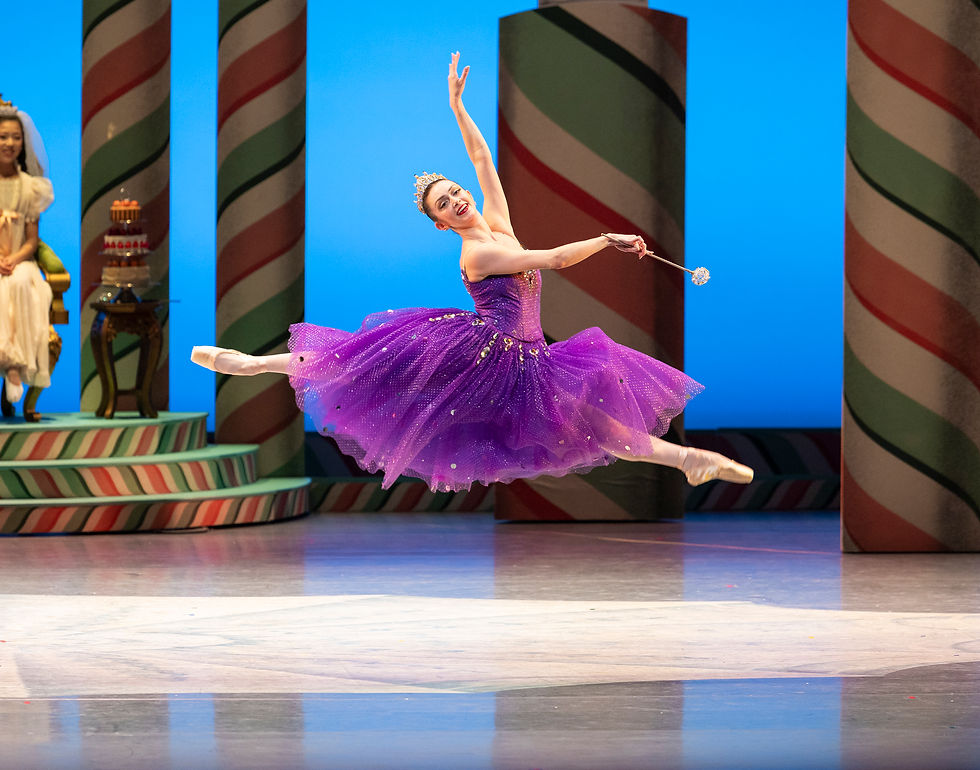
This vision of devotion, so pure in its essence, is a lingering balm. Alexei Ratmansky once said,“When you hear the pas de deux music, you hear the fear of losing a beautiful dream”, and indeed, far too soon, the wonder they’ve bestowed upon us is but a memory.
Whatever form they appear in, every Nutcracker shares one essential element: Pyotr Ilyich Tchaikovsky’s illustrious score. The Nutcracker, far too often dismissed as nothing more than fluffy children’s holiday entertainment, is woven of hidden meanings greater than one can uncover in a lifetime. Even without knowing what led Tchaikovsky to compose such a mournful pas de deux to close a “children’s ballet”, or the autobiographical inspirations that shaped his composition, one can feel that it is no simple score. While one critic called the score “astonishingly rich in inspiration” after its St. Petersburg premiere, many in the audience found the score too complex, a shock in its vast intricacy.
Though Tchaikovsky expressed initial reluctance about The Nutcracker, and claimed to not feel the same inspiration that filled his rapid composition of The Sleeping Beauty, look what arose out of such frustration! In The Nutcracker, Tchaikovsky preserves childhood in sound, capturing the fears, dreams, and unbridled hope that steep the ballet in nostalgia. As with all Tchaikovsky compositions, the depths that hide beneath the surface reveal a mind driven by incomprehensible detail. As Simon Morrison remarks in “Tchaikovsky’s Empire”, the “beat is harder to find after Drosselmeier’s appearance”, and meter is distorted in all the Act Two dances, as though warped by the dream. The two pinnacle moments of the ballet: the growing tree and the pas de deux, are mirror images, one a rising crescendo , the other a descending G minor scale repeated with prayer-like insistence.
The death of his beloved sister is ultimately what inspired Tchaikovsky to complete the ballet whose progress he had been rather disappointed with. Her loss, coming midway through his work, is quietly woven into the ballet. The blizzard recalls bluffs of snow around her house, a cherished memory that arises “a musical journey into a realm of enlightenment” (Morrison). In “Coffee”, we hear refrains of a Georgian lullaby that his sister knew: Iavana, a healing prayer whose lyrics translate to “bring relief to our children.” And of course, it is that melancholic grande pas de deux in which a painful nostalgia ushers in an overwhelm of soul-stirring meaning. Many scholars have found that this swelling descending scale echoes the rhythm of panikhida, the Russian Orthodox prayer for the dead, which would confirm why it falls upon our ears with a haunting, prayer-like reverence.
The Nutcracker is a ballet of duality. It is a sugary concoction of delight, sparking little feet to dance in the lobby and bringing eyes of all ages to a glow, and yet, it is also laden with startling profundity. In fairytales we find a depth of themes hiding beneath simple means, and likewise, in The Nutcracker, there is something for young and old. It holds both the marvelous delights of character, magic, humor, and fantastical reaches of imagination, and the soul-wrenching, memory-filled splendors that let sentimental eyes well at what it means to see this tale swell year after year.
For many people, The Nutcracker is all they will ever know of ballet, and should that be the case, then within its warm hue, they find some of ballet’s greatest magic encapsulated. In 1952, as The Nutcracker was already in the works, Balanchine wrote to Lincoln Kirstein: “The new generation which would come to the performances will be the future citizens of the United States…we have to do something for their souls and minds.” More than seventy years later, the success and importance of this heartfelt vision is difficult to overestimate.
Bringing The Nutcracker to life each year takes a mighty village, and were it not for these collective efforts and sacrifices, there would be no tradition or ritual to speak of. A tremendous thank you to all, for making this month-long marathon a reality, and for giving Seattle the greatest gift of all: pure, unfiltered wonder amidst the year's darkest days.

Sources
“Apollo’s Angels” by Jennifer Homans
“Dance Writings” by Edwin Denby
“Mr. B” by Jennifer Homans
“Nutcracker Nation” by Jennifer Fisher
“Tchaikovsky’s Ballets” by Roland John Wiley
“The Boy From Kyiv” by Marina Harss


This review is a beautiful reminder of the magic and charm of the Nutcracker Ballet .
As an adult the memories are rekindled every time I am fortunate to see this ballet again.
The review's poetic language create the images central to the ballet and I appreciated the detailed description .